The Roman Amphitheatre of Tarragona: History, Visit and Everything You Need to Know
A Monument Between Two Worlds
There are few places in the world where you can sit on ancient stone, look out to sea, and feel two thousand years collapse into a single moment. The Roman Amphitheatre of Tarragona — ancient Tarraco — is one of them.
Built into the slope of a hill overlooking the Mediterranean, this extraordinary structure was not merely a venue for spectacle. It was the beating heart of a city that governed half of the Iberian Peninsula. Today, as part of the Archaeological Ensemble of Tarraco, it carries UNESCO World Heritage status — and it remains one of the best-preserved Roman amphitheatres in the western world.
A Brief History
The Roman Foundation
Construction of the amphitheatre began in the 2nd century AD, during the height of Rome’s imperial power. Tarragona — then known as Tarraco — was no ordinary provincial city. It was the capital of Hispania Citerior, the most important Roman province in the Iberian Peninsula, and one of the wealthiest cities in the entire Roman Empire.
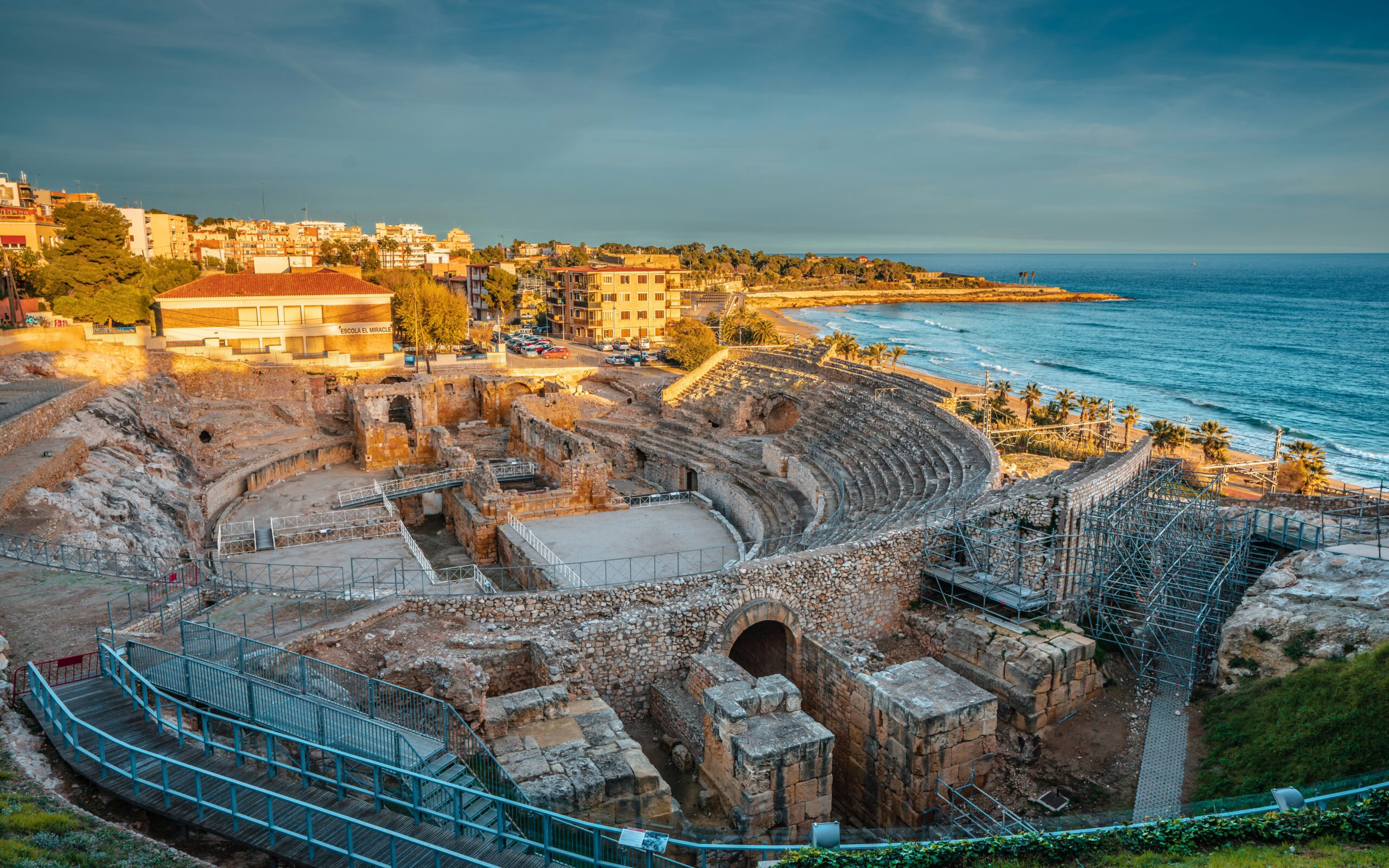
The amphitheatre was built adjacent to the sea, partially excavated into the rocky hillside, and could hold an estimated 14,000 spectators — a remarkable figure for a city of its era. The elliptical arena measured approximately 130 by 102 metres, making it comparable in scale to many Italian counterparts.
Like all Roman amphitheatres, it served as the stage for munera — gladiatorial combats — and venationes, wild animal hunts. Slaves, prisoners of war, and professional fighters known as gladiatores competed here for survival, glory, or both.
Martyrdom and Memory
In 259 AD, the amphitheatre became the site of one of the most significant events in the history of early Christianity in Hispania. The bishop Fructuosus of Tarragona, together with his deacons Augurius and Eulogius, was burned alive in the arena on the orders of Emperor Valerian.
Their martyrdom was witnessed by thousands. In the centuries that followed, they were venerated as saints, and their deaths transformed the very place of their execution into sacred ground.
From Arena to Church
As the Roman Empire declined and Christianity rose to dominance, the amphitheatre underwent a remarkable metamorphosis. In the 6th century, a Visigothic basilica was constructed directly within the arena — a deliberate act of consecration, converting a place of pagan spectacle and Christian martyrdom into a house of worship.
Centuries later, in the 12th century, this basilica was replaced by a Romanesque church dedicated to Santa Maria del Miracle, which stood until the early modern period. Its ruins remain visible today at the centre of the arena, adding another layer of history to an already extraordinary site.
What You Will See Today
The Arena
The central elliptical arena is the most immediately striking feature. Walking its length gives a visceral sense of the scale of Roman entertainment — and of the terror and exhilaration that must have filled this space on days of spectacle.
At the centre, the foundations and partial walls of the medieval church of Santa Maria del Miracle rise from the ground, a haunting reminder that this site has meant many different things to many different peoples across two millennia.
The Seating Tiers (Cavea)
The tiered seating — the cavea — survives in significant sections, particularly on the northern side. Carved from and built into the living rock of the hillside, these tiers once accommodated tens of thousands of spectators arranged by social rank: senators and dignitaries closest to the action, common citizens higher up.
Sitting on these ancient stones today, with the Mediterranean stretching to the horizon below, it is difficult not to feel the weight of time.
The Underground Chambers (Hypogeum)
Beneath the arena floor lie the subterranean passages and chambers of the hypogeum — a network of tunnels where gladiators prepared for combat, animals were kept before their release into the arena, and the machinery of Roman spectacle was organised. These spaces are partially accessible and profoundly atmospheric.
The View
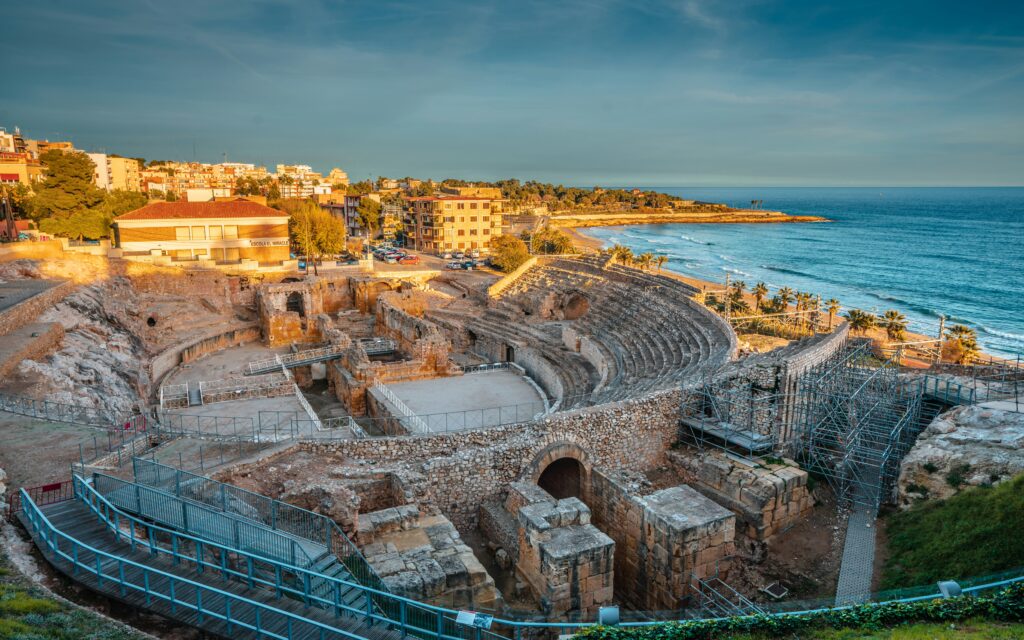
One of the most distinctive features of Tarragona’s amphitheatre — and one that sets it apart from most Roman equivalents — is its location directly above the sea. The view from the upper tiers across the Mediterranean is exceptional, and a reminder that Tarraco was above all a maritime city, oriented towards the sea that connected it to Rome.
Practical Information
Opening Hours
| Period | Hours |
|---|---|
| October – March | Tuesday to Sunday, 9:00 – 17:00 |
| April – September | Tuesday to Sunday, 9:00 – 21:00 |
| Mondays | Closed |
Hours may vary on public holidays. Always check the official Tarragona tourist board before visiting.
Admission
| Ticket | Price |
|---|---|
| Adults | €3.80 |
| Children under 16 | Free |
| Combined ticket (all Roman monuments) | €11.05 |
| Free entry | Sundays after 15:00 |
The combined ticket is strongly recommended if you plan to visit more than one Roman monument — it gives access to the Amphitheatre, the Roman Circus, the Pretori i Circ Romans, the Necròpolis Paleocristiana, and the Museu d’Història de Tarragona.
How to Get There
The amphitheatre is located at the eastern end of the Rambla Nova, Tarragona’s main boulevard, a short walk from the old town.
- On foot: 10 minutes from Tarragona railway station; 5 minutes from the old town
- By car: Parking available at the seafront (Passeig de les Palmeres) or in the old town car parks
- By bus: Urban bus lines 1 and 5 stop nearby
Address: Parc de l’Amfiteatre, s/n, 43003 Tarragona
Tips for Your Visit
Go early or late. In summer, the midday heat can be intense. The best light for photography is in the early morning or late afternoon, when the golden Mediterranean sun illuminates the stone beautifully.
Combine with the Balcó del Mediterrani. Just above the amphitheatre, the Balcó del Mediterrani offers one of the finest panoramic views in Tarragona. The combination of the two makes for a memorable hour.
Buy the combined ticket. The Roman monuments of Tarragona are best understood as a whole. The amphitheatre, the circus, the forum, the city walls — each illuminates the others. The combined ticket makes the full picture accessible and excellent value.
Allow at least 90 minutes. The site rewards unhurried exploration. Read the interpretation panels, descend into the hypogeum, sit in the cavea and look out to sea.
The Amphitheatre in Context: Tarraco’s Roman Legacy
The amphitheatre is just one element of a remarkable concentration of Roman heritage. Tarragona’s UNESCO-listed Archaeological Ensemble includes:
- The Roman Circus — where chariot races were held, one of the largest in the Roman world
- The Roman Forum — the administrative and commercial heart of the city
- The Roman Walls — among the oldest Roman military architecture in the Iberian Peninsula
- The Arch of Berà — a triumphal arch standing on the ancient Via Augusta
- The Tower of the Scipios — a funerary monument on the road to Rome
- The Centcelles Mausoleum — an extraordinary late-Roman monument near Constantí
Together, these sites make Tarragona one of the most significant destinations for Roman history outside Italy.
A Final Thought
The Roman Amphitheatre of Tarragona is not merely a ruin. It is a document written in stone — a record of power and spectacle, of faith and martyrdom, of a city that was once among the most important in the western world. To walk its ancient ground is to read that document with your own feet.
Come to see the stones. Stay for the sea.
Article by the VisitTGN editorial team · visittgn.com
Images: where credited, please respect author attribution.